
Many content creators believe automatic text modification is just simple synonym swapping. That outdated view misses the reality: modern AI text tools use sophisticated transformer models to understand context, adjust tone, and preserve meaning while enhancing readability. This guide reveals how automatic text modification actually works, what benefits it offers to marketers and creators, and how to choose the right tool for your workflow.
Table of Contents
- Introduction To Automatic Text Modification
- How Automatic Text Modification Works
- Common Misconceptions About Automatic Text Modification
- Benefits For Content Creators And Digital Marketers
- Practical Applications And Tool Features
- Common Challenges And Ethical Considerations
- Conclusion And Next Steps For Content Professionals
- Explore Tabs Editor For Powerful AI Text Modification
Key takeaways
| Point | Details |
|---|---|
| AI-driven process | Automatic text modification uses deep learning to change tone, style, and paraphrase content while preserving meaning. |
| Efficiency gains | Modern tools reduce editing workload by up to 40% and increase engagement by 25% through tone optimization. |
| Semantic accuracy | AI maintains meaning with up to 90% accuracy, balancing originality and clarity for professional content. |
| Practical applications | Tools like Tabs Editor offer simple interfaces for formal, informal, concise, or creative text transformations. |
| Ethical responsibility | Human oversight and transparency are essential to avoid plagiarism and maintain authentic voice. |
Introduction to automatic text modification
Automatic text modification is an AI-based process transforming text by analyzing context, tone, and style to produce paraphrased or stylistically adjusted versions. Unlike manual editing, where humans meticulously revise sentence by sentence, AI tools analyze entire documents instantly, applying semantic awareness to maintain meaning while changing expression. This capability revolutionizes content production workflows for creators and marketers who need consistent, efficient editing.
The distinction from traditional editing matters. Manual editing relies on human intuition and time investment, creating bottlenecks in content pipelines. Automatic modification delivers speed and consistency, processing thousands of words in seconds while maintaining semantic integrity. For digital marketers managing multiple campaigns or content creators producing daily posts, this efficiency transforms how quickly you can adapt messaging for different audiences.
AI text modification automates three core editing tasks:
- Paraphrasing content to avoid repetition and improve readability
- Adjusting tone to match audience expectations and brand voice
- Enhancing clarity by simplifying complex sentences or adding precision
This automation directly impacts content production workflows. You can now generate multiple versions of marketing copy, tailor educational materials for different reading levels, or adapt professional communications for various contexts without starting from scratch each time. The result is faster content turnaround and more consistent quality across all your channels.
How automatic text modification works
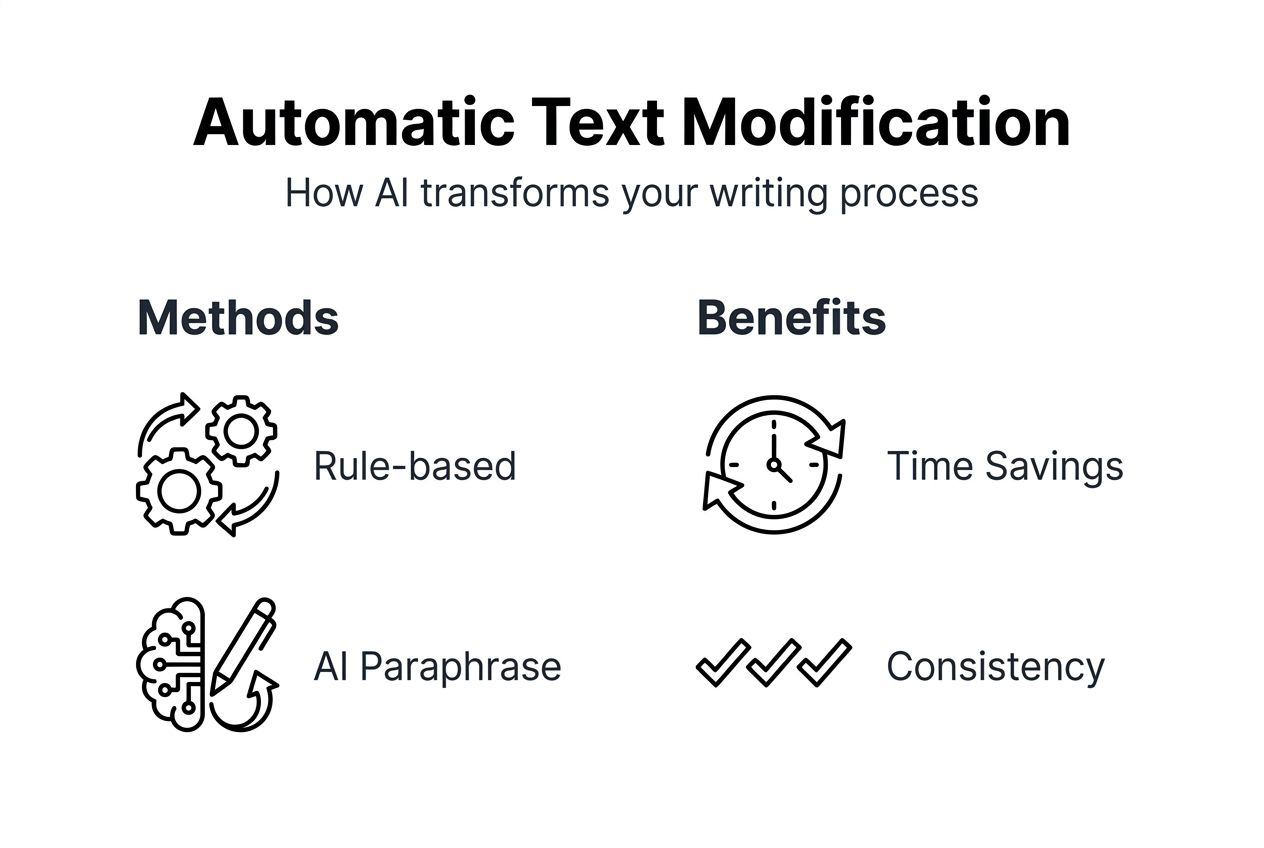
Automatic text modification uses AI models like transformers to understand semantic context and generate paraphrased or tone-adjusted variants. These models differ fundamentally from older approaches. Rule-based systems simply swapped words based on predefined dictionaries. Statistical methods analyzed word patterns but lacked deep understanding. Modern transformer models grasp meaning, context, and subtle linguistic nuances that make text sound natural.

Different AI-driven text modification approaches include rule-based substitution, statistical machine translation, and deep learning transformers. The evolution reveals why transformers dominate today:
| Approach | Mechanism | Limitation | Best Use |
|---|---|---|---|
| Rule-based | Dictionary synonym replacement | No context awareness | Simple word substitution |
| Statistical | Pattern matching from training data | Limited creativity | Template-based content |
| Transformer | Deep learning with attention mechanisms | Requires computational resources | Complex tone and style modification |
Transformers excel because they process entire sentences simultaneously, understanding how each word relates to others. This semantic understanding preserves meaning while enabling sophisticated tone adjustments. When you input text into a tool like the Tabs Editor AI paraphraser, the underlying transformer analyzes your content through three conceptual layers:
- Input analysis: Breaking down sentence structure, identifying key concepts, and mapping relationships
- AI transformation: Generating alternative phrasings while maintaining semantic links and adjusting for target style
- Output optimization: Refining grammar, ensuring coherence, and matching the desired tone profile
Pro Tip: Test AI outputs by reading them aloud. If the paraphrased version sounds unnatural or changes your intended meaning, adjust the style setting or provide more specific input context. Most quality tools offer multiple style options that let you fine-tune results.
This multi-layer approach explains why transformer model basics revolutionized natural language processing. Instead of treating text as isolated words, transformers model the relationships and dependencies that create meaning. For content creators, this means you get outputs that sound human-written while matching your specified tone, whether formal, conversational, or creative.
Common misconceptions about automatic text modification
The biggest myth is that AI only swaps synonyms, producing shallow, robotic text. This misconception stems from early rule-based tools that did exactly that. Modern AI goes far deeper, analyzing semantic relationships and context to create genuinely improved variations. You are not getting a thesaurus on steroids. You are accessing a tool that understands how language conveys meaning and emotion.
Another widespread concern is that AI-generated text lacks creativity or authenticity. In reality, the creative limitation lies in how you use the tool, not the technology itself. AI text modification amplifies your creative intent by offering variations you might not have considered. It serves as a brainstorming partner, presenting alternative phrasings that spark new ideas or better align with your audience.
Semantic drift worries creators who fear AI will distort their original message. While semantic drift can occur, modern AI maintains meaning with accuracy rates up to 90%, balancing originality and clarity. The key is understanding that no AI tool is perfect. Human review remains essential for catching edge cases where the AI misinterprets nuance or context.
"The challenge in AI paraphrasing is not just generating different words, but preserving the author's intent and the subtle connotations that give text its true meaning. Current models achieve impressive semantic fidelity, but human judgment still provides the final quality check."
Recognize these practical limits:
- AI may struggle with highly specialized jargon or domain-specific terminology
- Cultural references and idioms can confuse models trained primarily on general language
- Complex argumentative structures sometimes get simplified more than intended
Understanding these boundaries helps you use AI tools effectively. You set realistic expectations, review outputs critically, and intervene when the AI veers off course. This balanced approach maximizes efficiency while maintaining the quality your audience expects.
Benefits for content creators and digital marketers
Time savings top the list of benefits. Automatic text modification reduces editing workload by up to 40%, freeing you to focus on strategy and creativity rather than repetitive rewriting tasks. Instead of manually crafting five versions of an email subject line, you generate them instantly and choose the best performer. This efficiency compounds across campaigns, blog posts, and social media content.
AI models in text modification can adjust tone to match emotional or formal context, increasing reader engagement by an average of 25% over non-modified text. Tone adaptation is not cosmetic. It directly impacts how your audience receives and acts on your message. A formal tone builds credibility in B2B contexts. A conversational tone drives clicks in consumer marketing. AI lets you test both without doubling your writing time.
Consistency across channels becomes manageable when AI helps maintain brand voice. You define the tone once, then let the tool apply it to every piece of content. This consistency builds recognition and trust, especially when you are managing multiple platforms with different posting frequencies. Your LinkedIn articles, Twitter threads, and blog posts all sound unmistakably like your brand.
Pro Tip: Integrate AI text modification early in your content workflow, not as a final polishing step. Draft quickly, knowing you can refine tone and style instantly. This mindset shift reduces writer's block and speeds production because you are not trying to perfect every sentence on the first pass.
Additional concrete benefits include:
- A/B testing made simple by generating multiple headline or CTA variants in seconds
- Adapting existing content for new audiences without starting from scratch
- Maintaining productivity during high-volume content periods like product launches
- Reducing reliance on multiple editors or external writers for style variations
For digital marketers, these benefits translate directly to ROI. Faster content turnaround means more campaigns, more tests, and more data to inform strategy. For content creators, it means publishing consistently without burnout and experimenting with styles that expand your reach. Explore Tabs Editor features to see how these benefits apply to your specific content needs.
Practical applications and tool features
In practical use, automatic text modification tools like Tabs Editor provide a simple interface with button-based style selection. This design choice matters because it lowers the barrier to entry. You do not need to understand machine learning or natural language processing. You just paste your text, click the style that matches your goal, and review the output.
Modern tools offer multiple modification options:
- Formal: Elevates casual language for professional documents, proposals, or executive communications
- Informal: Makes stiff content conversational for social media, blog posts, or customer-facing emails
- Concise: Strips filler and redundancy to create tight, scannable copy for landing pages or ads
- Creative: Adds flair and variety to marketing copy, making it more memorable and engaging
These options empower users without AI expertise. A marketing coordinator can instantly adapt a press release for Twitter. An educator can simplify complex explanations for different grade levels. A sales professional can tailor pitch emails for different prospect personas. The versatility makes automatic text modification relevant across industries and roles.
Typical marketing tasks improved by these tools include:
- Creating multiple ad copy variants for split testing campaigns
- Adapting long-form content into snackable social posts
- Rewriting product descriptions to match different customer segments
- Generating email sequence variations to avoid repetitive messaging
- Transforming technical documentation into customer-friendly guides
The Tabs Editor tool overview demonstrates this accessibility. You input your original text, select your target style, and get instant results. The interface deliberately avoids complexity, focusing on the outcome you want rather than the technical process that delivers it. This user-centric design reflects a broader trend in AI text editing user experience, where simplicity and speed trump feature overload.
Common challenges and ethical considerations
Semantic accuracy and originality sometimes conflict. AI that stays too close to the original may not provide enough variation to avoid plagiarism concerns. AI that strays too far risks changing your intended meaning. Finding the right balance requires understanding your specific use case. Marketing copy can tolerate more creative liberty. Legal or technical documents demand stricter semantic fidelity.
Plagiarism risks emerge when users treat AI outputs as final products without review. Automatic modification generates text based on patterns learned from training data. If you publish AI-modified content verbatim, especially when paraphrasing existing published material, you risk unintentional duplication. Human oversight catches these issues. You verify that outputs are sufficiently original and accurately represent your ideas.
Ethical use of automatic text modification must address concerns about content originality and potential misuse for plagiarism. The industry recognizes this responsibility. Ethical frameworks emerging in 2026 emphasize transparency, user education, and built-in safeguards that alert users to potential originality issues.
Key considerations for responsible AI tool usage:
- Always review and customize AI outputs before publishing or distributing
- Disclose AI assistance when transparency matters to your audience or industry standards
- Avoid using AI to paraphrase copyrighted material without proper attribution
- Maintain your authentic voice by treating AI as a collaborator, not a replacement
- Stay informed about AI content ethics guidelines as they evolve
Human oversight remains non-negotiable. AI excels at pattern recognition and generation, but it lacks judgment about appropriateness, sensitivity, and strategic fit. You bring the context, audience understanding, and brand knowledge that makes content effective. AI brings speed and variation. Together, you create better content faster than either could alone.
The ethical path forward balances leveraging AI efficiency with maintaining human accountability. This means using tools transparently, reviewing outputs critically, and always prioritizing authentic communication over pure automation.
Conclusion and next steps for content professionals
Automatic text modification represents a fundamental shift in content creation efficiency. You now have AI partners that understand semantic context, adjust tone instantly, and generate variations that would take hours manually. The technology has matured beyond simple synonym swapping into sophisticated language understanding that preserves meaning while enhancing expression.
The transformation these tools offer is real. Faster content production, more consistent brand voice, better audience targeting, and reduced editing bottlenecks all contribute to measurable improvements in your content marketing results. The 25% engagement increase and 40% time savings are not theoretical. They reflect real outcomes when you integrate AI text modification thoughtfully into your workflow.
Choosing the right tool requires evaluating a few key criteria. Look for accuracy in preserving your intended meaning. Prioritize ease of use so your entire team can benefit without extensive training. Check for style variety that matches your content needs. Consider integration options if you need the tool to work within existing platforms or workflows.
Balance AI output with human editing. AI generates the variations, you select the winners. AI suggests the tone, you ensure it matches your brand. AI accelerates production, you maintain quality control. This partnership approach maximizes the benefits while minimizing the risks.
Start experimenting today. The barrier to entry is low, especially with accessible tools designed for non-technical users. Try the Tabs Editor paraphrasing tool on your next blog post or marketing campaign. Test different styles. Compare engagement metrics. You will quickly discover which applications deliver the most value for your specific content challenges.
Explore Tabs Editor for powerful AI text modification
Tabs Editor delivers the AI-driven text modification capabilities discussed throughout this guide. The platform offers instant paraphrasing and tone adjustment through an intuitive interface designed specifically for content creators and marketers who need results without complexity.
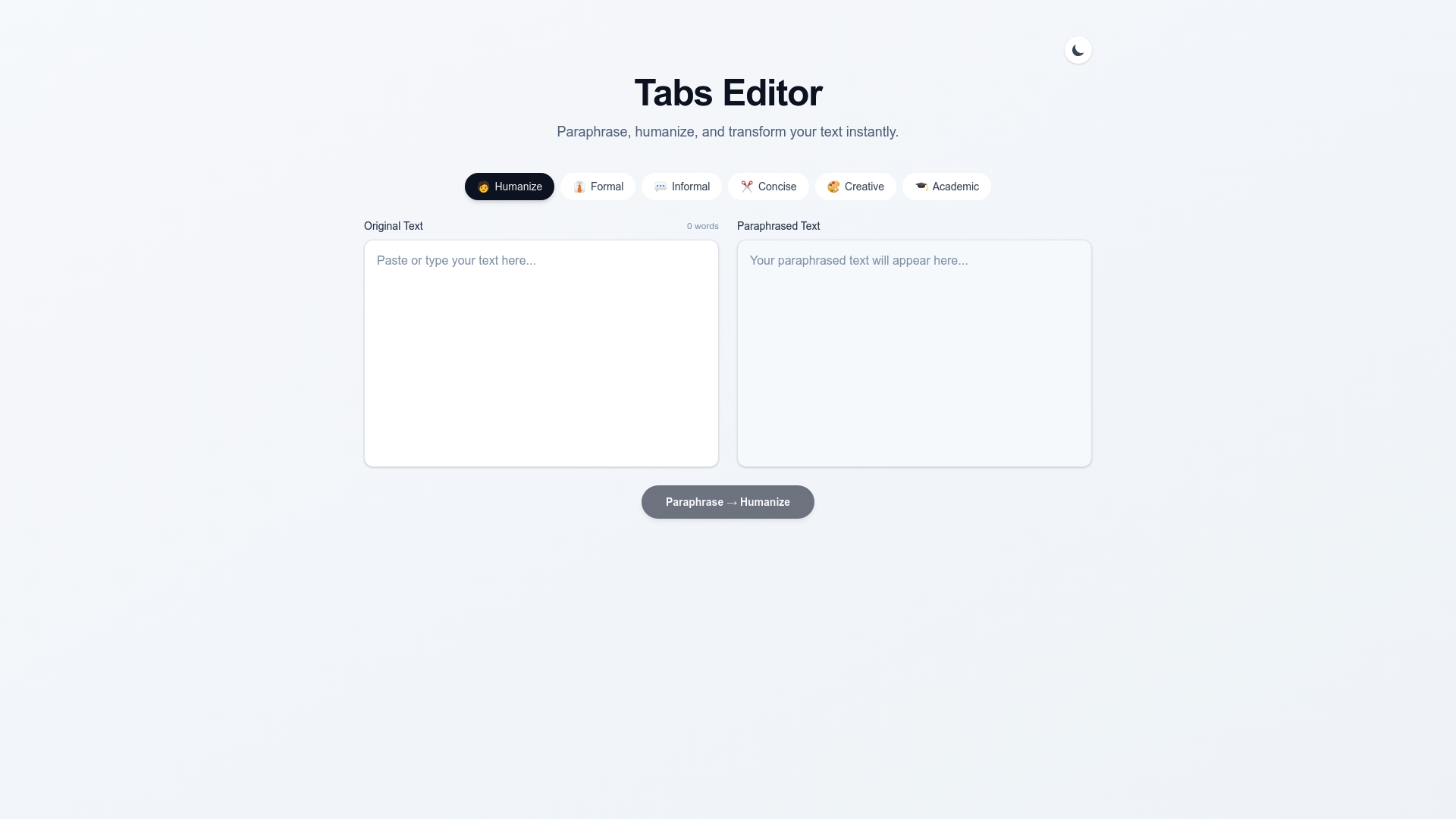
The tool provides formal, informal, concise, and creative style options that match the diverse needs of modern content production. Whether you are adapting marketing copy for different channels, enhancing blog readability, or tailoring professional communications, Tabs Editor handles the transformation while you focus on strategy and messaging.
Non-experts achieve professional results immediately. The button-based interface eliminates the learning curve, letting you experiment with different tones and styles until you find the perfect voice for each audience. Visit the Tabs Editor AI paraphraser to experience how automatic text modification can accelerate your content workflow and improve engagement across all your channels.
FAQ
What types of text can automatic text modification handle?
Automatic text modification works best on marketing copy, blog content, professional emails, and educational materials where tone and style flexibility matter. These tools excel at content requiring audience adaptation without changing core meaning. They are not ideal for highly technical or legal documents requiring expert precision, where even minor semantic shifts could create compliance or accuracy issues.
How accurate is AI in preserving the original meaning?
Modern AI achieves up to 90% semantic accuracy when modifying text, maintaining your core message while changing expression. This high fidelity makes the technology reliable for most content applications. However, human editing is recommended to ensure complete meaning retention, especially for nuanced arguments or content where precision is critical.
Can automatic text modification improve content engagement?
Tone and style adjustments enabled by automatic text modification have shown up to 25% engagement increases in measured campaigns. The improvement stems from better alignment between content tone and audience expectations. When your message matches how your audience prefers to receive information, they engage more readily, whether through clicks, shares, or conversions.
Is it ethical to use AI for modifying text?
Ethical use requires transparency and human oversight to maintain authenticity and avoid plagiarism. Review and customize all AI outputs before publishing to ensure originality and accuracy. Disclose AI assistance when your industry or audience expects transparency. Treat AI as a collaborative tool that enhances your creative work rather than replacing your judgment and voice.