
Paraphrasing academic texts without losing meaning or risking plagiarism challenges most students and researchers. Many struggle to balance originality with accuracy while maintaining scholarly tone. This guide delivers proven strategies to transform your paraphrasing skills, ensuring clarity, integrity, and confidence in every academic project.
Table of Contents
- Understanding Paraphrasing In Academic Writing
- Prerequisites: What You Need Before You Start Paraphrasing
- Step-By-Step Methodology For Effective Academic Paraphrasing
- Common Mistakes When Paraphrasing And How To Fix Them
- Using Ai Tools To Support Paraphrasing Responsibly
- Quality Check: Avoiding Plagiarism And Ensuring Originality
- Expected Outcomes And Success Metrics For Paraphrasing
- Enhance Your Paraphrasing With Tabs Editor
- Frequently Asked Questions
Key takeaways
| Point | Details |
|---|---|
| Deep understanding required | Proper paraphrasing demands thorough comprehension of source material before attempting any rewrites. |
| Systematic process works | Following structured steps from reading to plagiarism checking improves both originality and accuracy. |
| Common mistakes avoidable | Recognizing patchwriting, over-reliance on synonyms, and citation failures prevents plagiarism risks. |
| AI assists cautiously | Tools like Tabs Editor speed up paraphrasing but require manual review to preserve meaning and tone. |
| Verification ensures integrity | Running plagiarism checks and confirming semantic fidelity upholds academic standards and protects your work. |
Understanding paraphrasing in academic writing
Paraphrasing means restating someone else's ideas using completely different words and sentence structures while preserving the original meaning. In academic contexts, it demonstrates your understanding of source material and integrates research seamlessly into your arguments.
This skill matters because proper paraphrasing prevents plagiarism accusations and shows intellectual engagement with scholarship. Unlike direct quotes that simply reproduce text, paraphrasing proves you've processed information deeply enough to express it independently.
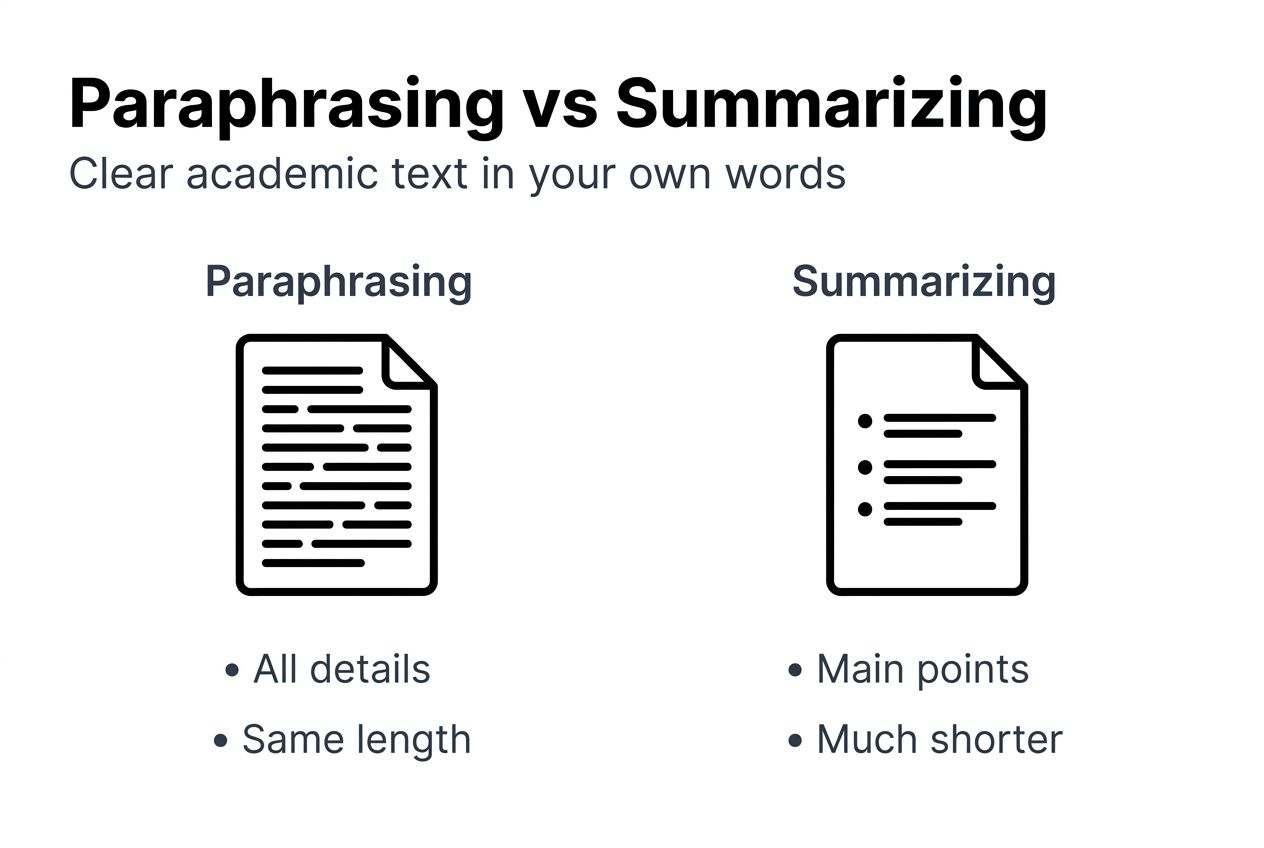
Three distinct approaches exist for incorporating sources:
- Paraphrasing rewrites all details from a passage in new language while keeping length similar
- Summarizing condenses main points only, removing supporting details and examples
- Quoting reproduces exact words within quotation marks for specific phrases or definitions
Knowing when each method fits your purpose strengthens academic writing. Paraphrasing works best for explaining complex concepts in clearer terms or connecting ideas across multiple sources. Summarizing suits lengthy arguments you need to reference briefly. Quoting preserves powerful original phrasing or technical terminology that loses impact when reworded.
Prerequisites: what you need before you start paraphrasing
Successful paraphrasing requires preparation beyond simply reading source texts. You need foundational knowledge and specific resources to paraphrase ethically and effectively.
Start with comprehensive understanding of your source material. Read passages multiple times, looking up unfamiliar terms and grasping how arguments connect. Shallow comprehension leads to patchwriting, where you accidentally copy phrases because you don't truly understand them.
Familiarize yourself with citation rules for your discipline. APA, MLA, Chicago, and other styles have specific requirements for crediting paraphrased ideas. Check your institution's academic integrity policies too, since some define acceptable paraphrasing practices explicitly.
Essential tools and resources include:
- Plagiarism detection software like Turnitin or Grammarly to verify originality
- Citation management tools such as Zotero or Mendeley for tracking sources
- Style guides for your required citation format
- Optional AI paraphrasing assistants like Tabs Editor for efficiency
| Resource Type | Purpose | Examples |
|---|---|---|
| Plagiarism Checkers | Detect text overlap with sources | Turnitin, Grammarly, Copyscape |
| Citation Managers | Organize references and format citations | Zotero, Mendeley, EndNote |
| Style Guides | Ensure proper academic formatting | APA Manual, MLA Handbook |
| AI Paraphrasing Tools | Accelerate rewriting process | Tabs Editor, QuillBot |
Gathering these resources before starting saves time and reduces errors during the paraphrasing process.
Step-by-step methodology for effective academic paraphrasing
Follow this proven sequence to paraphrase academic texts accurately and originally. Each step builds on the previous one, ensuring you maintain meaning while creating genuinely new expression.
-
Read the source thoroughly until you grasp every concept and connection. Reread complex sections. Look up terminology.
-
Take notes on key ideas without copying phrases. Jot down concepts in your own casual language to distance yourself from original wording.
-
Set the source aside and write your paraphrase from memory. This forces original expression and prevents unconscious copying.
-
Compare your draft with the source to verify you've captured the meaning accurately without mimicking sentence structures.
-
Revise for academic tone by adjusting vocabulary and ensuring clarity. Vary sentence lengths and structures from the original.
-
Add citations immediately in the required format. Every paraphrased idea needs attribution even without quotation marks.
-
Run plagiarism detection to catch any accidental similarities before submission.
Pro Tip: After writing from memory, wait several hours before comparing with the source. This mental distance helps you spot unintentional copying more easily.
| Paraphrasing Stage | Time Investment | Key Outcome |
|---|---|---|
| Deep Reading | 15-20 minutes per page | Complete comprehension |
| Note Taking | 5-10 minutes per page | Concept extraction |
| Draft Writing | 10-15 minutes per paragraph | Original expression |
| Comparison & Revision | 5-10 minutes per paragraph | Accuracy verification |
| Citation & Checking | 5 minutes per source | Academic integrity |
Research shows AI-powered tools reduce rewriting time by 50% when combined with manual editing. This efficiency gain matters for large research projects, but the manual review step remains non-negotiable for maintaining quality.
Common mistakes when paraphrasing and how to fix them
Recognizing typical paraphrasing errors helps you avoid plagiarism and produce stronger academic writing. These mistakes appear frequently even among experienced researchers.
Patchwriting happens when you copy the source's sentence structure and swap out a few words with synonyms. This looks like paraphrasing but counts as plagiarism because you haven't truly restructured the ideas. Fix this by writing from memory after closing the source and starting sentences completely differently.
Over-reliance on synonyms without changing sentence structure creates awkward, unnatural text. Simply replacing words one-to-one rarely works because context affects meaning. Instead, restructure entire sentences and explain concepts in your own logical flow.
Confusing paraphrasing with summarizing causes problems when you need to convey all details from a passage. Studies indicate over 35% of papers confuse these approaches, leading to incomplete information. Remember: paraphrasing maintains similar length and includes all supporting details, while summarizing condenses to main points only.
Failing to cite paraphrased content represents a serious academic integrity violation. Many students mistakenly believe only direct quotes need citations. Every paraphrased idea, statistic, or argument from a source requires attribution.
Pro Tip: Read your paraphrase aloud without looking at the source. If it sounds like natural speech in your voice, you've likely succeeded. If it sounds stilted or oddly formal, you may be too close to the original phrasing.
Avoid these patterns to strengthen your paraphrasing:
- Keeping the same keywords in the same order
- Starting sentences identically to the source
- Maintaining the source's organizational structure
- Leaving technical terms undefined when context requires explanation
Using AI tools to support paraphrasing responsibly
AI paraphrasing platforms offer significant efficiency gains but require careful, ethical use in academic contexts. Understanding both benefits and limitations helps you leverage these tools appropriately.

Time-saving represents the primary advantage. Research confirms combining AI tools with manual review reduces time by 50% while maintaining academic tone. This efficiency matters when working with extensive literature reviews or multiple source integrations.
Manual review remains essential because AI can inadvertently alter meaning. Algorithms lack deep understanding of nuanced academic arguments, sometimes producing technically correct but semantically inaccurate paraphrases. Always compare AI output against the source to verify accuracy.
Responsible AI paraphrasing involves:
- Using tools as starting points, not final products
- Verifying every AI-generated sentence preserves original meaning
- Adding your own analysis and connections between ideas
- Maintaining consistent academic tone throughout
- Citing sources properly regardless of AI assistance
Ethical considerations extend beyond accuracy. Some institutions prohibit AI writing assistance entirely, while others permit it with disclosure. Check your specific policies before using any AI tools. Even when allowed, overreliance on AI undermines the learning process that paraphrasing facilitates.
"AI paraphrasing tools serve best as efficiency multipliers for students who already understand proper paraphrasing techniques. They accelerate mechanical rewriting but cannot replace critical thinking about source material."
Transparency matters too. If your institution requires disclosure of AI tool usage, document which platforms you used and how extensively. This protects you from accusations of misrepresentation.
Quality check: avoiding plagiarism and ensuring originality
Verification steps before submission protect your academic reputation and ensure your paraphrasing meets ethical standards. This final review catches issues that emerged during drafting.
Plagiarism detection software provides objective measurement of text overlap. Run your work through institutional checkers or commercial platforms like Turnitin. Aim for similarity scores under 15%, though acceptable thresholds vary by discipline and assignment type.
These tools highlight matching text but require human judgment. Short common phrases or technical terminology may show matches without constituting plagiarism. Review each flagged passage contextually.
Semantic fidelity checks confirm your paraphrase accurately represents source meaning. Place your paraphrase and the original side by side. Ask yourself:
- Does my version convey the same main argument?
- Have I preserved important qualifications or limitations?
- Did I maintain the original's level of certainty or tentativeness?
- Are cause-and-effect relationships still clear?
Pro Tip: Have a peer read your paraphrase without seeing the source, then explain back what they understood. If their explanation matches the source's meaning, your paraphrase succeeds.
Citation verification ensures every borrowed idea receives proper credit:
- Check that citations appear immediately after paraphrased content
- Verify citation format matches required style exactly
- Confirm page numbers or paragraph markers when required
- Double-check spelling of author names and publication years
Institutional originality requirements may exceed basic plagiarism avoidance. Some programs expect certain percentages of original analysis versus source material. Review assignment rubrics for specific expectations.
Expected outcomes and success metrics for paraphrasing
Measuring your paraphrasing improvement helps identify strengths and areas needing development. These benchmarks provide concrete goals for skill advancement.
Originality scores above 85% indicate effective paraphrasing. Most plagiarism checkers calculate this automatically. Scores below 85% suggest too much similarity with sources, requiring additional revision.
Clarity improvements show in readability metrics. Tools like Hemingway Editor or Graded.pro assess sentence complexity and vocabulary level. Academic writing should target graduate reading levels while remaining clear and direct.
| Success Indicator | Target Metric | Measurement Method |
|---|---|---|
| Originality | 85%+ unique text | Plagiarism detection software |
| Clarity | Grade 16-18 reading level | Readability checkers |
| Citation Accuracy | 100% sources credited | Manual verification |
| Meaning Preservation | Peer comprehension match | Comparative reading |
| Time Efficiency | 50% faster with practice | Self-tracking |
Reduced plagiarism risk manifests through consistently low similarity scores across multiple assignments. Track your scores over time to see improvement patterns.
Writing confidence grows as paraphrasing becomes more natural. You'll notice spending less time agonizing over word choices and more time engaging with ideas substantively. This shift indicates skill mastery.
Feedback from instructors provides qualitative assessment. Comments about integration of sources or depth of analysis reflect successful paraphrasing supporting your arguments rather than dominating them.
Enhance your paraphrasing with Tabs Editor
Tabs Editor streamlines the paraphrasing process without sacrificing the clarity and originality academic work demands.
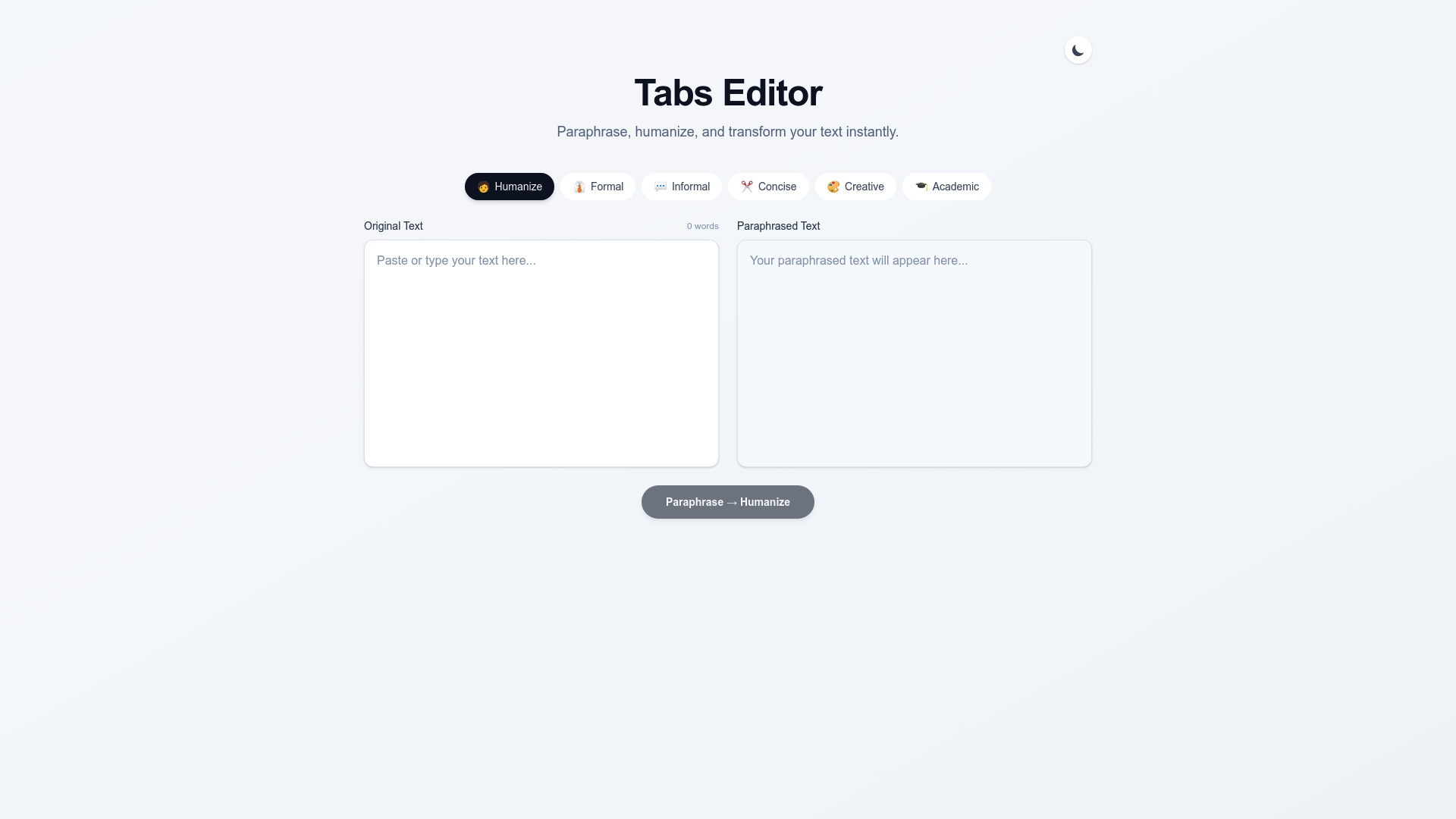
This AI-powered platform combines advanced paraphrasing algorithms with humanizing features that maintain natural academic tone. Unlike basic synonym replacers, Tabs Editor restructures sentences intelligently while preserving precise meaning.
The tool supports multiple writing styles, letting you adjust formality levels for different academic contexts. Whether drafting literature reviews or discussion sections, you control the output tone.
Manual review features built into the platform encourage responsible AI use. Side-by-side comparison views help you verify accuracy before finalizing paraphrased text. This integrated workflow speeds up the mechanical rewriting process while keeping critical thinking central.
Frequently asked questions
What is the main difference between paraphrasing and summarizing?
Paraphrasing rewrites all details from a passage using different words while maintaining similar length. Summarizing condenses content by extracting only main points and removing supporting examples or explanations. Use paraphrasing when you need to discuss specific details and summarizing when brevity matters more than comprehensiveness.
How can I avoid plagiarism when paraphrasing academic texts?
Understand the source material thoroughly before attempting to rewrite it in your own words. Always cite paraphrased ideas immediately with proper attribution in your required citation style. Run your completed work through plagiarism detection software to catch any unintentional similarities before submission.
Are AI paraphrasing tools reliable for academic writing?
AI tools speed up paraphrasing by 50% but require manual review to maintain meaning and tone. They work well as starting points but cannot replace human judgment about accuracy and context. Always verify AI-generated paraphrases against source material and edit for precision before using them in academic work.
What are effective steps to improve my paraphrasing skills?
Practice regularly with diverse academic texts from your field to build familiarity with disciplinary language and argumentation patterns. Seek feedback from peers, writing center tutors, or instructors on your paraphrasing attempts. Use plagiarism checkers and AI assistants like Tabs Editor responsibly as learning tools, not replacements for developing your own paraphrasing abilities through deliberate practice.